FROM THE DRIVEWAY
My wife Chris and I drove down to the Wild Center in Tupper Lake a couple weekends ago to find the Trolls — the six giant ones the Danish artist Thomas Dambo tucked along two miles of forest trail for the summer. You don’t so much view them as hunt them. You walk, you sweat, you swat a blackfly or two, and then the trees open up and there’s a wooden giant the size of a house looking down at you like it’s been waiting.
Chris got there first and just stopped, looking up, not saying a word. I caught myself doing the same — two grown adults gone quiet in front of a giant made of firewood. And the whole time, I was thinking about Jaxson and Charlee, who are four and two, and how badly I want to bring them back here this fall to watch their faces the moment the trees open up.
Here’s the part I keep turning over. Those trolls are built out of scrap. Broken pallets, snapped fence boards, the busted-up leftovers of other people’s projects — the stuff you’d pay to have hauled to the dump. And we drove an hour and a half, bought tickets, and hiked two miles in bug spray to stand in front of it. Nobody on that trail was thinking about board-feet of reclaimed lumber.
That’s the thing I want to talk about this month: the enormous gap between what a thing is made of and what it’s worth.
THE BIGGER PICTURE
A Price Is a Conversation
In the book, Charlee’s dad asks what she’s going to charge for a cup of lemonade. She hasn’t thought about it. She thinks fast and says, “A dollar.” He whistles and says, “That’s steep, kid.” She doesn’t know what steep means, but she doesn’t want to admit it, so she says the only thing she’s completely sure of:
“It’s a scorcher.”
I want to stop the tape right there, because that nine-year-old just did something most founders take twenty years to learn how to do.
She didn’t defend her price with a spreadsheet. She defended it with a reason the customer already feels. It’s a scorcher. You’re hot. The lemonade is cold. A dollar is nothing against how badly you want this right now. She priced the thirst, not the lemons.
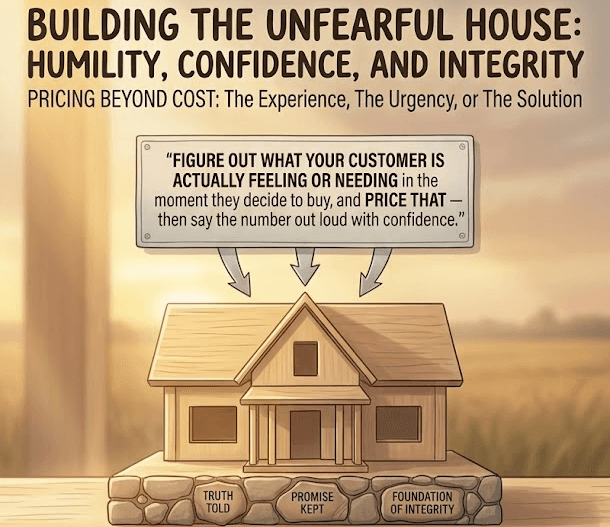
Here’s the lesson underneath the moment: a price is not a fact about your product. It’s a conversation about your customer.
Most people set prices by looking down — at their costs, their hours, what the lemons rang up to at the store ($14.62, in Charlee’s case, a number that ruins her afternoon for about ninety seconds). Cost tells you the floor. It does not tell you the price. The price lives in the other person’s head, in the gap between what they have and what they want — and on a scorcher, that gap is enormous.
Which brings me back to the trolls. Thomas Dambo has been called the world’s leading recycle artist; he’s built more than a hundred of these giants around the world, and the whole point is that they’re made of trash. The materials are worth roughly nothing. But the experience — the hunt, the hush that falls over the whole trail the moment the trees open up, a carload of kids whispering “is he real?” — people will happily pay for that, and drive a long way to do it. The wood is the cost. The wonder is the price. Those are two completely different numbers, and the second one is the only one the customer is actually buying.
You can watch grown companies get this right and wrong in real time. The same bottle of water is fifty cents from a vending machine and four dollars at 11 p.m. from a hotel minibar — and the difference isn’t the water, it’s the scorcher. When Apple priced the first iPhone, they weren’t pricing glass and silicon; they were pricing what it felt like to have the internet in your pocket in 2007. When a plumber charges what feels like a fortune to stop a burst pipe at 2 a.m., you’re not paying for twenty minutes of labor — you’re paying for your kitchen to stop flooding. Every one of those is Charlee saying it’s a scorcher.
I spent years being bad at this. When my wife and I opened Jake’s on the Water, I wanted to price the food by adding up what was on the plate. What I slowly learned is that nobody drives out to a lakeside restaurant to buy the cost of the ingredients. They’re buying the last warm evening of summer, the table by the water, the night they don’t have to cook. Price that, honestly and fairly, and everybody leaves happy. Price the ingredients and you’ll quietly go broke being the best deal on the lake.
So here’s the part that’s useful on a Monday. The next time you have to name a number — for your product, your rate, the thing you keep undercharging for — try Charlee’s move. Don’t start with your costs. Start with one sentence: What is the scorcher? What does the person on the other side of the table actually feel in the moment they decide? Price that. Then check it against your costs to make sure you’ll survive.
A price set that way is one you can say out loud without flinching — which, not coincidentally, is the only kind of price a customer believes.
OFF THE CLOCK
🎧 What I’m listening to
Long Lake Bangers — a playlist my daughter Allie put together. I won’t pretend I knew half the songs on it, but that’s the fun; she has genuinely great taste, and I’ve caught myself humming things I can’t name. Handing the aux cord to the next generation turns out to be its own small pleasure.
📖 What I’m reading
I’m a sucker for a coming-of-age story — that clear-eyed adolescent voice discovering the truths the rest of us have gone numb to. Boy’s Life by Robert McCammon absolutely floored me; I read it in a few days and I already know I’ll read it again. If you’ve ever wanted to remember what it felt like to be young and see everything as magic, start there.
📺 What I’m watching
Just rewatched Dead Poets Society. Still a terrific story, and cast perfectly — the kind of movie that quietly asks what you’re doing with your one life and then trusts you to answer. Holds up completely.
FROM THE STAND
Catch up: this month’s Short Take
If you missed “Look at Me: The Case for Shameless Self-Promotion,” the one-line version is this: humility and silence are not the same thing. You can be humble about your character and relentless about your message. Funny how it rhymes with pricing — naming your price out loud and pointing at your own work out loud are the same act of nerve.
ONE MORE CUP
On the drive home, Chris and I were already planning the trip back — this time with Jaxson and Charlee, once the fall colors are in. I have a feeling a four-year-old and a two-year-old are going to lose their minds, in the best possible way.
Because that’s the thing. A pile of broken pallets, worth nothing, turns into a day you drive home already wanting to give the people you love. That’s the whole trick, in the woods and at the card table alike.
Figure out what you’re really selling. Then say the number like you mean it.
Until next month,
Marc Compeau